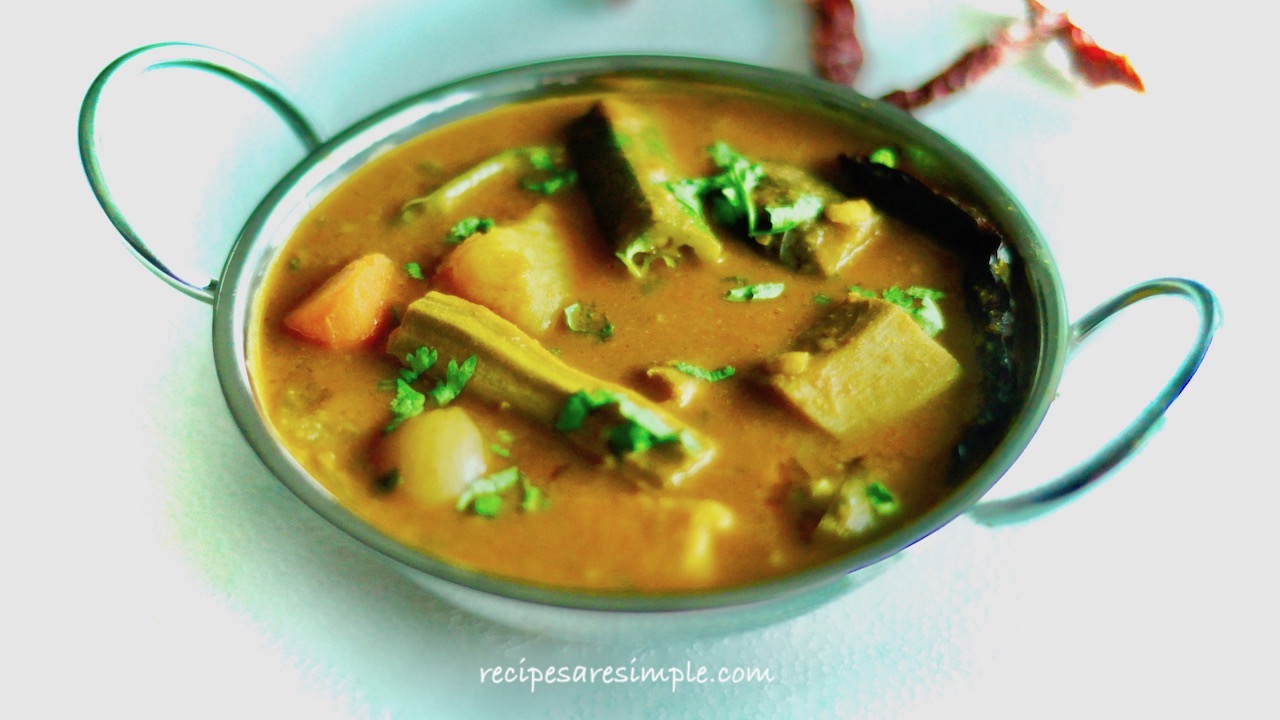
Kerala Sambar is made with traditional roasted, ground spices and coconut paste.
Prep time: 20-30min Cook time 20min 8-10 servings.
Kerala Tradtional Varutharacha Sambar
® This is a RAS signature Recipe©
A detailed introduction, step-wise images and related links is available on the
Recipe Intro ↓ Check it out or scroll down for the Recipe and Video⇓.

EAT AND TELL!!! Let us know if you tried – Kerala Tradtional Varutharacha Sambar
| ♦Mail me your pics and testimonials 🙂 – recipesaresimple@gmail.com ♦If you make the dish and share it on your social media please don‘t forget to tag me @recipesaresimple and hashtag it #recipesaresimple on any platform. ♥Please rate the recipe if you have tried it below ↓♦Quick Browse to see All Recipes by Category.♦World Cuisines to browse recipes by Country ♥Thanks for visiting www.recipesaresimple.com |
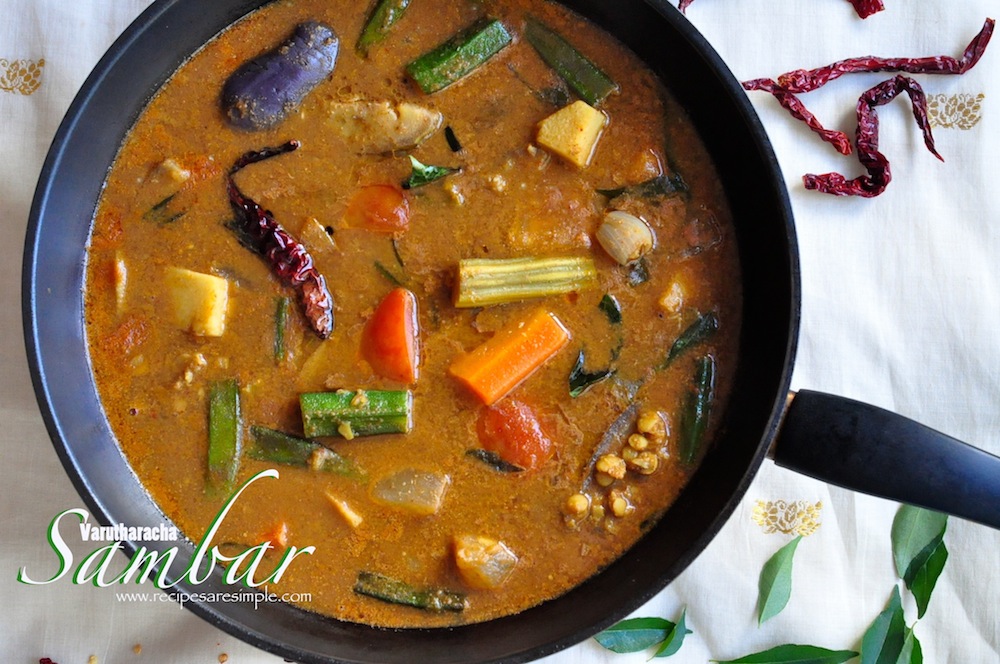
Kerala Traditional Varutharacha Sambar
Description
"Varutharacha" literally means "roasted and ground." This refers to the freshly made spice paste which is prepared by roasting and grinding a blend of whole spices and fresh grated coconut. It's the traditional method of making this delicious Sambar.
Ingredients:
For the special roasted Varutharacha Sambar Masala powder:
For tempering:
Instructions
-
Leave the tamarind pulp in hot water to soften before you start.
-
Peel, scrape, and chop all the vegetables as specified (see notes).
-
Add the vegetables to a bowl of water to prevent any discoloration.
-
Rinse the Pigeon peas ( tur dal ). Add to a large pressure cooker with turmeric powder and ½ tsp salt. Pressure cook for 1 steam whistle on medium heat. Turn off the heat. Leave the cooker to cool on its own.
-
Remove half the dal to a bowl. Leave the rest as well as the broth in which it was cooked in the pressure cooker.
-
To this, add all vegetables except ladies' fingers and tomatoes. Add another tsp of salt or so.
-
Pressure cook again on medium heat for a single steam whistle. However this time we will release the steam manually. (Place the cooker under running water till you can open the cooker). This prevents overcooking the vegetables, causing them to get mashed. Set aside.
-
To a dry pan or wok, add the coriander seeds, dried red chilli, urad dal, chana dal, and fenugreek seeds followed by the coconut. Roast, stirring continuously. Add the Asafoetida. Roast till the coconut is toasted and golden brown. Do not allow any blackening of the spices or coconut. If this occurs, throw it out and start again. Don't try to make it work. Trust me
-
Add the roasted ingredients to a small heat-proof grinder ( or wait till it cools down). Grind with just a little water to a paste. (As smoothly as possible).
-
Add to the vegetables and bring to a simmer: allow the raw smells to dissipate. Also, return the reserved cooked dal. Allow to simmer and thicken. Taste and add salt if needed.
-
In another wide-mouthed pan or wok, heat some of the oil. Add the okra and stir-fry a bit till deep green in color.
-
Add the curry leaves and the chopped tomato. Cook down till the tomatoes are softened and the okra is cooked tender.
-
Add the entire cooked dal and vegetable mixture (from the pressure cooker) to the pan.
-
Add the tamarind solution and allow it to simmer for a short time.
-
Temper: Heat the remaining oil in a small pan. Add the fenugreek seeds allow to crackle. Add dried chilli and curry leaves. When aromatic and fried, add to the curry.
-
Add chopped fresh coriander leaves over the Sambar and serve hot.
Note
- When chopping, cutting vegetables for the Sambar, it is important to remember that the different vegetables are cooked differently, and that is why we keep the pieces on the larger side. Don't cop the vegetables too small. Traditionally, vegetables like carrots, ladies' fingers, drumsticks, plantains are cut into finger-length, thick pieces. Potatoes, eggplant, are cut into big squarish chunks, and winter melon, elephant yams are cut into squarish cubes. etc.
- Half of the dal is removed in this recipe before cooking the vegetables with the rest of the dal. The reason for this is to keep some texture and bite to some of the dal while mashing up the rest in the final dish.
- When grinding the roasted coconut mixture, traditionally, a stone grinder is used. The taste is improved.
- Fresh Asafoetida always gives better flavor, but if you only have the powdered form, use that.
- Read more about the origin of the Sambar dish.
- Key Ingredients: Mixed Sambar vegetables, Shallots, Coconut, Dals, Spices, Tamarind, Coconut Oil, Salt, Curry Leaves, Coriander Leaves.